
What to do in the first 72 hours after losing crypto to a scam, one step at a time
Published: Last reviewed: How we edit
Take it in five small steps over the first 72 hours. Send no more money. Secure your accounts and wallets. Save all the evidence. Report to the exchange, to the stablecoin issuer if one is involved, and to the police. Ignore anyone who approaches you offering recovery. Acting early helps, because some platforms can step in only while funds are still traceable, but no one can promise a result.
Not sure what to do next? Write to us:
Hours 0 to 2: stop more money leaving
Pay the scammer nothing more, even when they insist one last fee will release your funds. That is a standard second stage of the same scam. Send nothing else, and do not borrow money to pay.
Next, protect what is still yours. If a seed phrase, an access code or screen access went to the scammer, treat the wallet as exposed. Create a new wallet on a clean device and move what remains into it, then change the passwords on your email, exchange and phone accounts.
- Close any remote access tool and remove every app the scammer had you install.
- Turn on two factor authentication through an authenticator app, not SMS, for your email and exchange accounts.
- If you can do it safely, revoke the token approvals on the affected wallet.
- Phone your bank if ordinary money payments were part of it, and ask if a recall is possible.
Hours 2 to 12: keep the evidence safe
Evidence vanishes quickly: scam sites go dark and chat accounts get deleted. Capture it before you do anything else with the case.
Resist the urge to delete conversations in anger. Take screenshots that show the dates, and keep the original messages. Write the story down as a timeline while you remember it clearly.
- The hash, wallet address, amount and date of each transfer.
- Screenshots of the site, the app, the chats, the emails and any profiles involved.
- Every web address, name, username and phone number tied to the scammer.
- Statements from the bank or card that funded each transfer.
- A written timeline: who contacted you, what they promised and what you sent.
Hours 12 to 36: tell the right places
Make your reports side by side rather than in sequence. Every report earns a reference number, and you will want those numbers later.
Did your funds pass through an exchange? Write to its fraud or compliance team with the hashes and the timeline. A stolen stablecoin that is centrally issued may also be something its issuer can act on, given a valid request. Either kind of platform may freeze funds that are still there, yet each makes its own decision.
- Your own exchange first, then whichever exchange received the funds, if the trail shows it.
- Your local police or national cybercrime unit, with your list of evidence.
- Whoever issued your bank account or card, if ordinary currency was involved.
- The network or app that put you in touch, such as social media or a dating service.
Hours 36 to 60: follow where the funds went
Every transfer leaves a public record, so you can often see where stolen funds went. Paste the receiving address into a block explorer and write down the next address in the chain. When that address belongs to an exchange deposit, let the exchange and the police know.
An independent specialist can turn that trail into a formal report for police and platforms to use. The report does not bring funds back on its own. What it does is support a request.
Hours 60 to 72: watch for recovery scammers
People who were scammed once get targeted again within days. Messages turn up on social media, by email and by phone, from people calling themselves investigators, hackers or lawyers who say they can retrieve your funds for a fee.
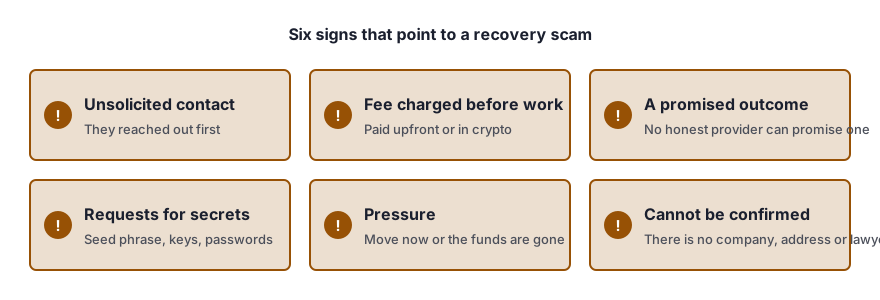
Leave unsolicited offers unanswered. A real provider has no need of your seed phrase, does not demand payment before saying whether it can help, and does not promise results. Our separate guide lists the red flags in detail.
After the three days are over
Start a single folder for report numbers and replies. Do not expect quick answers. Weeks may pass before police or platforms respond, and plenty of cases close without any funds coming back.
Should the sum be significant, you may request a free assessment from us. Our answer is honest about whether the evidence supports a route. If it does, we prepare the package and bring in independent lawyers and analysts. We cannot recover funds ourselves, and a seed phrase, private key or password is something we will never request.
Questions people ask
Have I missed my chance if more than 72 hours have gone by?
Not at all. Early action helps because funds can still be at a platform able to step in, yet the same steps apply later on: keep the evidence, make your reports, and request an assessment. Certain routes narrow as time passes, so begin today.
Is it a good idea to confront the scammer or ask for a refund?
No. Any contact tips them off to delete evidence, and it gives them an opening to ask for more money. Go quiet, hold on to every message and file, and spend your energy on reports and on securing your accounts.
Can the police get my crypto back?
They may investigate, and now and then authorities can seize funds. Results differ widely between countries and cases, and recovery is uncommon. File a report regardless, since the reference number helps with banks and platforms.
Is an exchange able to reverse a blockchain transfer?
No, nobody can reverse a blockchain transfer. An exchange can sometimes freeze funds still on its platform, provided a valid report reaches it in time, though it is under no duty to do so.
Is it real when a stranger offers to hack the scammer's wallet?
Treat it as a scam. Hacking a wallet is a crime, and no honest provider offers it. Most likely this is a second scammer after an upfront fee or your seed phrase.
How we can help
- Tracing stolen crypto and requesting freezes. Follow stolen crypto, ask exchanges and issuers to freeze it, and file a police report.
- Reading a blockchain analytics report. A traced source-of-funds report, written for a compliance team to use.
- DeFi exploit and bridge hack help. Following a DeFi exploit or bridge hack. We help with tracing, alerts and reporting.
- Appealing a stablecoin freeze. Build a documented appeal for Tether, Circle or another stablecoin issuer.
This page gives general information only. It is not legal advice.