
Stolen or scammed crypto: tracing the funds and sending freeze requests while it still counts
Published: Last reviewed: How we edit
Timing counts after a theft. Independent specialists can follow the funds across the blockchain, and a freeze request plus a police report can go to any exchange or stablecoin issuer holding them. A freeze works only when the funds land with a party able to freeze them, and a return is never promised. We coordinate each step. No payment is requested by us until the assessment is done.
Not sure what to do next? Write to us:
Everyday situations
- You sent funds to a scam address within the past few hours or days
- Someone else moved stablecoins like USDT or USDC out of your wallet
- The funds were divided among many addresses and then landed in an exchange deposit
- A fake website tricked you into signing a transaction, and the wallet was emptied
- A fraudulent platform lists a balance, blocks withdrawals and keeps asking for more fees
- A police report is on file, yet no one has contacted the exchanges involved
This fits if you
- Your crypto went to a bogus investment platform, a romance scammer or an impostor
- Phishing or a malicious approval left your wallet or exchange account emptied
- You paid in crypto for a product, job or service that turned out not to exist
- The fraud is already reported, and you want the funds followed until they reach somewhere a freeze is possible
- Someone reached out offering to recover lost funds, and you want to know if the offer is genuine
How the case runs
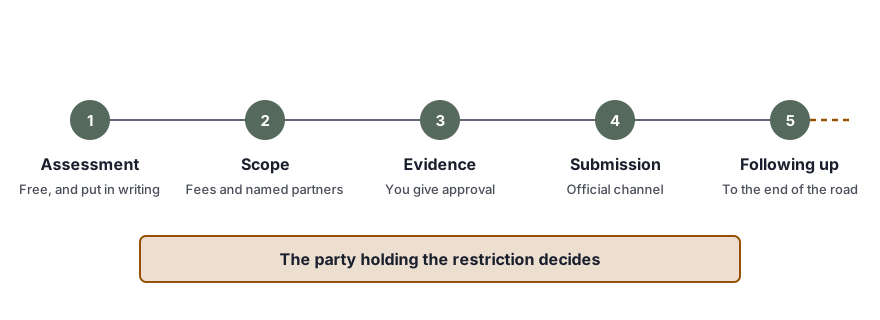
- A free first look
Send the transaction details and a short account of events. Our written answer covers whether a trace is worth trying, what looks realistic, and which items we need first.
- Scope and fee, in writing
Should we proceed, the scope, the fee model and the independent specialists involved are given to you in writing, ahead of any payment.
- Tracing and the report
Specialists follow the funds and write up a report. We go through it with you, explaining where the money sits now and where it might still be stopped.
- Police report and freezes
We help you file or update the police report, and freeze requests go to the parties the trace named. Copies and every reference number reach you.
- Following up
We watch for replies and help with further questions. If a request is refused, or the funds have moved out of reach, you hear it from us plainly.
What we do
- Pin down the facts early
Together we list transaction hashes, addresses, dates, amounts and each message the scammer sent. We also point out which accounts to secure and what to stop doing, which keeps the trail clean.
- Arrange the on-chain tracing
Independent blockchain analysts follow the funds onward from your transaction, through splits and swaps, and see where they end up: an exchange, a stablecoin address or a private wallet. What they find is written up in a report.
- Prepare the police report and its evidence
Exchanges and issuers tend to respond to law enforcement first, so a police report gives a freeze request real weight. We help you describe what happened clearly and attach the trace, which makes the report straightforward to act on.
- Send the freeze requests
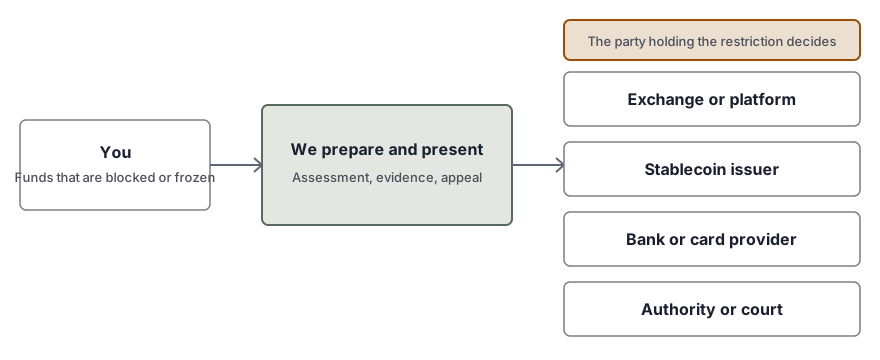
If the trace reaches an exchange or issuer, we help you send a structured request carrying the report reference, the addresses and the evidence. The recipient makes the call, and many will want a formal order first.
- Hand legal steps to independent lawyers
Once funds are identified and the sum warrants it, independent licensed lawyers can weigh civil action or a court order. We prepare the file and coordinate, and we tell you plainly when no realistic route is left.
What to have ready
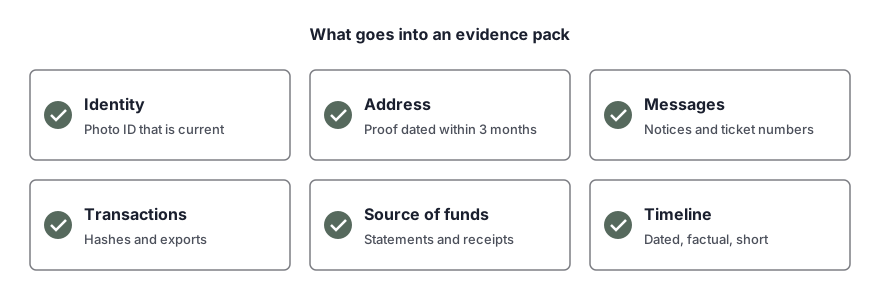
- The hashes and wallet addresses for each transfer you sent
- Screenshots of the chats, emails, ads, websites and profiles the scammer used
- Statements from your exchange or wallet that show the outgoing transfers
- Bank records, should you have bought crypto in order to send it to the scammer
- Your police report number, or whatever is needed to file one
- A photo ID and a proof of address for whoever files the report
- A brief timeline running from first contact to the final transfer
What we cannot do
- A freeze can happen only when the funds arrive with a party able to freeze them, for example an exchange or stablecoin issuer. Once funds rest in a private wallet, a freeze is generally out of reach.
- No return of funds, timeline or outcome is promised. A good number of cases stop at a completed trace, without any recovery.
- This is the part we cannot change: an exchange, issuer or police force decides for itself whether to act.
- Your seed phrase, private keys and passwords are not ours to ask for, and no payment is requested before an assessment.
Questions people ask
Is it possible to freeze stolen crypto?
Sometimes. It works only when the funds arrive with a party that can stop them, like an exchange or stablecoin issuer, and that party agrees to act. Nobody apart from the owner can freeze funds sitting in a private wallet.
How soon should I act?
As soon as you reasonably can. Scammers often move funds within hours, across many addresses or into an exchange. A quick trace and an early freeze request improve the odds of finding the money where a freeze is still possible.
Should I file a police report first?
It helps a great deal. Many exchanges and issuers give law enforcement requests priority over private ones. File as soon as you can, even with details missing, and add the trace later.
Will you get my funds returned?
Nobody honest can make that promise. Our part is tracing the funds, sending freeze requests and lining up legal help. If any money returns, it will follow from the route the funds took and from other people's decisions.
A company contacted me offering to recover my funds. Is that safe?
Take care. Recovery scammers go after earlier fraud victims, frequently claim contacts inside exchanges, and ask for a fee in advance. A real service explains what it can and cannot do, and does not request money before an assessment.
What is the first thing to do today?
Take it one step at a time. Send no more money, pay no fee for funds to be released, and secure your accounts. Keep the transaction hashes and chats. Report to the police and the platforms involved, and then ask for an assessment so the trace can begin.
How long it takes
The first hours and days count most, since funds can be moved or cashed out fast. A trace may take days, and exchanges or police can take weeks to reply. What we expect is shared with you once the assessment is done.
Fees
The assessment comes first and costs nothing. A written scope and fee model follow it. Payment up front is never requested until we have looked at your case and said whether we can help. Fees →
Related situations
- Reading a blockchain analytics report. A traced source-of-funds report, written for a compliance team to use.
- Appealing a stablecoin freeze. Build a documented appeal for Tether, Circle or another stablecoin issuer.
- When authorities freeze your crypto. Your crypto is held by authorities. We connect you with independent lawyers. We cannot give legal advice.
- DeFi exploit and bridge hack help. Following a DeFi exploit or bridge hack. We help with tracing, alerts and reporting.
Read next
Sources
These are the official or authoritative pages behind this page. Sources get updated over time, so check them for the current wording.
- Cryptocurrency, Internet Crime Complaint Center · FBI IC3
- Worried about crypto exchange losses? Don't pay money for help recovering money · US Federal Trade Commission
- Can I recover crypto lost to a scam? · Kraken
This page gives general information only. It is not legal advice.