
Blockchain analytics report: tracing where your funds came from, for compliance
Published: Last reviewed: How we edit
A blockchain analytics report maps how funds reached an address: the transfers, the counterparties involved, and any risk flags raised. Independent specialists prepare it using public ledger data, and we shape it into a plain document a compliance team can read. It can show the path the funds took. It cannot prove who controlled an address, why a payment was made, or that a platform has to accept it.
Not sure what to do next? Write to us:
Everyday situations
- An exchange asks where a large deposit came from
- Coins bought on the market passed through your own wallets, then got flagged
- A payment arrived, and only later you learned the sending address carried a risk label
- A bank asks questions about money from a crypto sale
- An old wallet can only be used again once its history is explained
- You may need a formal document to support a disagreement or a request for review.
This fits if you
- A compliance team wants to know where your crypto came from, and your own records do not tell the full story
- Your funds moved through several hops, and you need that path written out clearly
- A platform flagged your deposit, and you would like to see what its screening likely picked up
- A lawyer or an accountant wants the on-chain history laid out in neutral terms
- You want to look at an address before accepting a large transfer
How the case runs
- No-cost evaluation
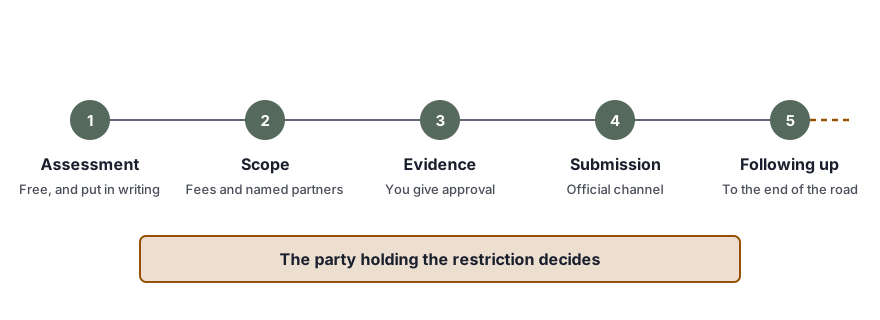
You tell us who is asking for what, and why. We reply in writing on whether a report would help, and what it would have to contain.
- Scope and fee in writing
Before any payment is made, we walk you through the question being asked, which addresses are included, which specialists will take part, and how the fee is structured.
- Following the funds
Independent specialists follow the transfers and label each counterparty. We then check the draft for gaps and for any claims the data cannot back up.
- Checking the numbers
Before we finalise the report, we check the chain history against your documents. If anything does not line up, we ask you first.
- Handing it over
First, you get the finished report, along with a short guide on presenting it. Next, if it helps, we can send it on your behalf to the platform or your lawyer. That is the part we can take off your hands.
What we do
- Pin down the question the report answers
First, we agree on the exact question: where one deposit came from, what one wallet's history shows, or whether a flagged counterparty was involved. A narrow, plain question gives a reviewer a document they can actually use.
- Let independent specialists trace the transactions
Analysts who work independently trace the movement of funds on the public ledger. They mark the counterparties they can recognize and note each hop along the way. We choose them ourselves, give them a clear brief, and then check that the scope still fits your question.
- Point out risk flags and what they mean
The report shows if the funds touched exchanges, mixers, sanctioned parties or scam-linked addresses. Every flag comes with a plain explanation and the transfers behind it.
- Match the chain against your own records
On its own, the data from Ledger transfers looks sparse. So we connect each traced payment with your bank statements, receipts and exports from the exchange. Step by step, the report becomes one plain, consistent story rather than a bare list of hashes.
- Hand the document to the reviewer
You get a structured report: a summary, the path of the funds, a table of transfers and a brief note on method and limits. Whether to send it to the platform or a lawyer stays your call.
What to have ready
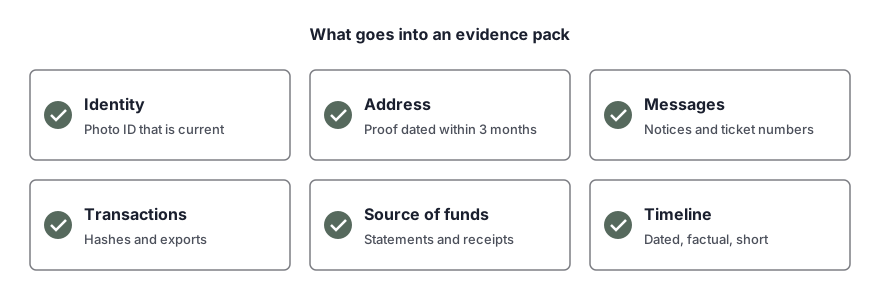
- Which wallet addresses are in scope, and which ones are yours
- Transfer hashes, or the dates and amounts for the transactions that matter to you
- The platform, bank or lawyer's exact question
- Exchange exports and your trade history for that period
- Bank statements or receipts that show how the funds were bought in the first place
- A prior report, risk score or screening result shown to you
What we cannot do
- A report traces how funds moved on the public ledger. It cannot show who controls an address, why a payment was made, or whether the money is clean.
- Counterparty labels come from analytics data, and those labels can be incomplete or mistaken. For each one we state how confident we are and on what basis.
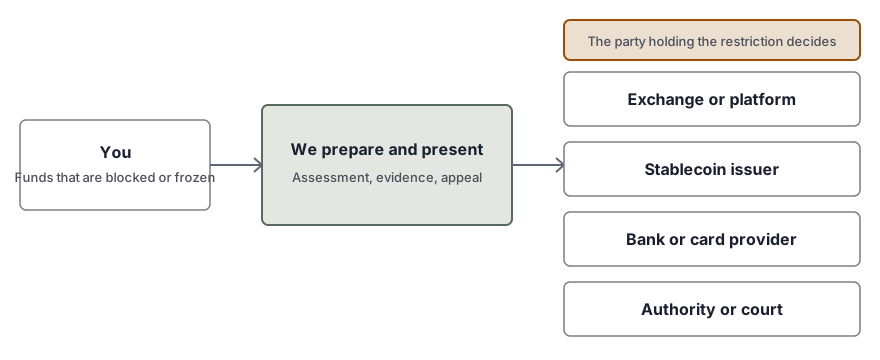
- A platform may simply ignore the report. No one can compel a compliance team, an issuer or an authority to accept it or reverse a decision. That part we cannot change.
- Privacy tools, cross-chain bridges and trades settled off the ledger can interrupt the trace. The report states plainly where the trail ends.
- For safety, we do not need your seed phrase, private keys, or passwords. Our tracing only requires publicly available addresses.
Questions people ask
What does a source-of-funds report based on blockchain analysis contain?
Inside, you will find a short summary, the route your funds took from the earliest source we could identify to your address, a table of each transfer, counterparties with labels, risk flags that come with explanations, and a short note on our method and its limits. The report is written for a compliance reader, not a technical audience, so it keeps the plain wording.
Can a blockchain report prove that my funds are legitimate?
No. The report shows where the funds traveled and how the counterparties are labeled. Whether the money was earned or bought legitimately is a separate question, and that is why we match the report against your bank statements and purchase records.
Will an exchange take this report?
Some compliance teams find it helpful. Others rely on their own tools and treat it only as background. No one can promise how it will be received. A clear report paired with matching documents tends to carry more weight than a raw list of transactions.
Do you need access to my wallet?
No. Tracing works from public addresses and transaction hashes. And please never share a seed phrase, private key or password with anyone offering to produce a report. A real analyst has no need for them.
What happens if the trace passes through a mixer or a bridge?
The report flags the spot where the trail grows uncertain and lays out what is known on each side of it. Some bridges can be followed. Mixers, usually, cannot. We state the limit plainly instead of guessing past it.
Is this the same thing as a risk score?
No. A risk score is one number produced by a screening tool. A report walks through the transfers sitting behind that number. It can support you when you challenge a score that does not reflect the real history.
How long it takes
Timing depends on how many addresses are involved, how deep the trace must go, and how quickly you can provide matching records. After the assessment you get an estimate.
Fees
The assessment costs nothing. Fees for a report depend on scope and complexity, and you receive a written quote before paying. Nothing is charged before we tell you whether a report would help at all. Fees →
Related situations
- Find out who froze your crypto. Learn who is behind the freeze and which next steps are realistic.
- Packs for source of funds and wealth. We can help you compile clear documentation showing your source of funds and wealth for banks and exchanges.
- Disputing wallet risk flags and screening results. Flagged as high risk by a screening tool: trace the funds and dispute the label.
- Tracing stolen crypto and requesting freezes. Follow stolen crypto, ask exchanges and issuers to freeze it, and file a police report.
Read next
This page gives general information only. It is not legal advice.