
Frozen or flagged wallets on any network: cases accepted from USD 50,000
Published: Last reviewed: How we edit
Only whoever controls the restriction can unblock a wallet: a token issuer, custodian, exchange, payment service or authority. We cannot do it ourselves. What we do is prepare the case, bring it to the right party, and coordinate the independent specialists and lawyers working alongside. That work is costly, so we accept cases from USD 50,000. We cannot guarantee any outcome.
Not sure what to do next? Write to us:
Minimum case size: USD 50,000. We accept wallet unblocking cases starting at this amount. Below it, the specialist and legal work simply costs more than the case makes sense for.
Everyday situations
- The issuer of a stablecoin has frozen the balance at your address
- After a compliance review, a custodian keeps a wallet in a restricted state
- Screening tools flagged an address, and services now refuse funds coming from it
- One network froze a wallet, and anything bridged away from it inherits the flag
- A business wallet was restricted once a counterparty was tied to a sanctioned or fraudulent address
- An authority made a request, a hold followed, and the holder cannot get any information
This fits if you
- Your wallet or address has been put on a blacklist or marked by screening, leaving a big balance out of reach
- An issuer, custodian or service holds the restriction, and it is not a technical fault
- Your funds are spread over several networks, and the restriction touches more than one
- Ordinary support channels were tried and failed, and the sum is big enough to justify formal work
- Your company must get a frozen treasury wallet, or one holding customer funds, examined
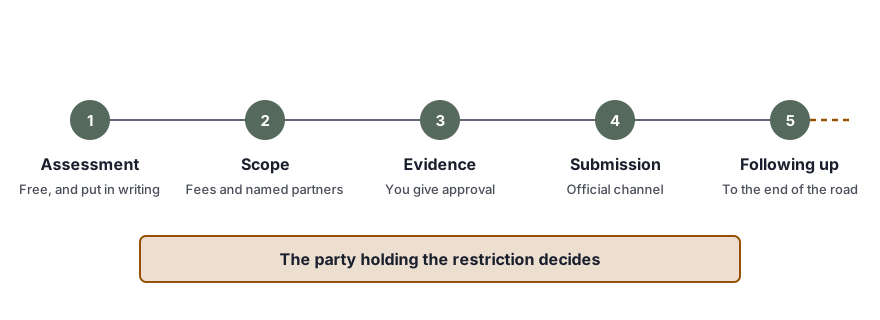
How the case runs
- A free first look
Tell us about the wallet, the networks and what you know. In writing, we say whether the case fits and whether it reaches the minimum case size.
- Scope and fee, in writing
Before anything is paid, you get the scope, the fee model and the names of the independent specialists and lawyers involved.
- Preparing the case
Specialists analyze the chain history while you send documents through a secure channel. We close any gaps before anything goes out.
- Putting it forward
The case goes to the issuer, custodian or service, or to the authority by way of counsel. You keep copies and all reference numbers.
- Following up and closing
We watch for responses, handle further questions, and tell you plainly when no route remains.
What we do
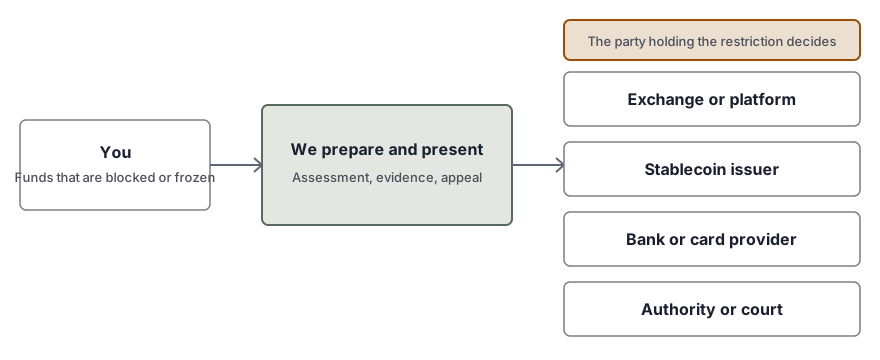
- Find who truly controls the restriction
We follow the restriction back to its owner, whether issuer, custodian, exchange, payment service or authority. Only that party can lift it, so each later step rests on getting this right.
- Judge viability and whether the case fits
Amount, facts and likely ground all get a look. If the route is weak, or the case falls under the size where specialist and legal costs make sense, we say so honestly.
- Prepare the evidence and analysis together
Independent specialists produce a transaction history and a source-of-funds analysis. We join their work with your identity, ownership and acquisition records so that the case file reads as one consistent whole.
- Put the case before the decision-maker
The formal request or appeal is drafted by us and sent through the proper channel with its exhibits. When legal process underlies the restriction, independent licensed lawyers take that part.
- Keep several networks and parties in step
When funds or flags cross multiple networks or services, one timeline and one document set serve everyone. Each party then sees identical facts, and your account never contradicts itself.
What to have ready
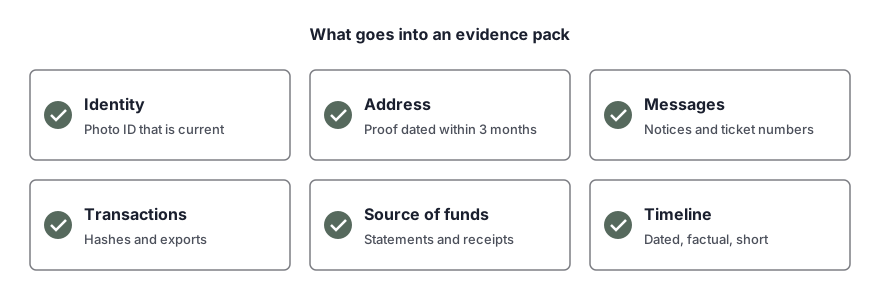
- The frozen or flagged addresses, with the networks they live on
- Hashes of the main incoming and outgoing transactions
- Proof that the wallet is yours, shown without handing over keys or a seed phrase
- Photo ID issued by a government plus an address document; companies add their corporate papers
- Records of how you obtained the funds: bank transfers, invoices, exchange exports
- Whatever the issuer, custodian, service or authority sent you: notices, emails, tickets
- A written timeline of what happened
What we cannot do
- Unblocking a wallet is not something we can do ourselves. It happens through whoever controls the restriction, and that party decides.
- No issuer, custodian, service or authority can be compelled by us to act, and we promise neither a result nor a timeline.
- Cases begin at USD 50,000. Under that amount, specialist and legal costs typically outweigh what a case could reasonably recover, so we tell you that rather than take your fee.
- Helping alter or backdate a document is something we refuse, and cases with no realistic route are ones we do not take on.
- Your seed phrase, private keys and passwords are never ours to ask for, and neither is remote access.
Questions people ask
Who is able to unblock a frozen wallet?
The party that put the restriction in place, or controls it, is the only one who can lift it. For a stablecoin that is normally the issuer; for a hosted account, the custodian or exchange; for a hold ordered by authorities, the authority or a court. No outsider can override any of them.
Why does the minimum case size sit at USD 50,000?
A serious case calls for blockchain analysts, careful document preparation and often a licensed lawyer, and those costs are real. Under this size they would eat most of what might be recovered, so saying no early is the more honest choice.
Is the minimum a charge?
No, it is the smallest balance we accept. The assessment is free, and a fee model follows in writing afterwards. Nothing is due until we have told you whether we can help.
What if my case falls below USD 50,000?
Other pages on this site, like exchange account unblocking or issuer appeals, may suit you better. Our guides also let you do much of the groundwork yourself. If we cannot take the case, we will say so plainly.
Is access to my private keys part of unblocking a wallet?
No, never. You can show control without keys, for instance by signing a message. Whoever asks for a seed phrase or key is not working in your interest, so stop all contact with them.
Does one unblocking cover the same wallet on every network?
One chain can restrict a wallet while another leaves it untouched, because a freeze normally attaches to a token on a network. Each network is mapped on its own, and we list the restrictions that exist.
How long it takes
Timing varies a great deal. Reviews by issuers and custodians may run for weeks, and anything involving legal process can run for months. An estimate follows the assessment, and we revise it as things change.
Fees
The assessment costs nothing. Cases begin at USD 50,000 because the work calls for paid analysts and often lawyers. Fees are quoted in writing once the assessment is done, and none is requested before we say whether we can help. Fees →
Related situations
- Find out who froze your crypto. Learn who is behind the freeze and which next steps are realistic.
- Appealing a stablecoin freeze. Build a documented appeal for Tether, Circle or another stablecoin issuer.
- Reading a blockchain analytics report. A traced source-of-funds report, written for a compliance team to use.
- When authorities freeze your crypto. Your crypto is held by authorities. We connect you with independent lawyers. We cannot give legal advice.
Read next
Sources
These are the official or authoritative pages behind this page. Sources get updated over time, so check them for the current wording.
This page gives general information only. It is not legal advice.