
Circle (USDC) address blocked or frozen: what the official pages state
Published: Official pages last read: How we edit
According to Circle, an address can be blocked from sending or receiving USDC in a few limited situations: mainly legal orders, urgent government requests or security threats. Blocklisting is not the same as reversing a completed transfer, and Circle may remove an address once an authority lifts the order or the security concern ends. If your funds were moved without your consent, Circle says to contact law enforcement first.
We have no connection to Circle (USDC). We are a separate service, we cannot sway its decisions, and nothing here comes from Circle (USDC) officially.
Not sure what to do next? Write to us:
What the platform's own pages say
- In its help article, Circle states that under limited conditions, described in its Stablecoin Access Denial Policy, it is able to prevent a single blockchain address from sending or receiving USDC or EURC. [1]
- The article explains that blocklisting, also called access denial or freezing, is not the same as reversing a transaction. USDC and EURC transfers are irreversible, so Circle cannot undo or recall a transfer that has already completed. [1]
- According to that page, the listed situations include following laws and valid legal orders issued by a recognised US or French authority or court, answering certain government requests marked as urgent, and taking action when Circle itself judges that a security threat makes this necessary. [1]
- According to the article, a transfer into or out of a blocked address can fail, and any funds tied to that address might stay out of reach until the blocklisting is lifted. [1]
- According to Circle, an address can come off the blocklist once the authority involved formally confirms that a legal obligation or order has been lifted, or once a security incident no longer calls for the restriction. [1]
- If money moved without your agreement, contact local law enforcement quickly. You should include the sending and receiving addresses, the transaction hash, and the date, time, and amount. [1]
- Per the article, law enforcement may send valid legal process straight to Circle, which then reviews it under its own policy and the applicable law. [1]
- In its v2.2 announcement, Circle explains that the blocklisting feature built into its smart contracts allows Circle to stop chosen addresses from sending or receiving USDC and EURC, and that this runs under its Access Denial policy. [2]
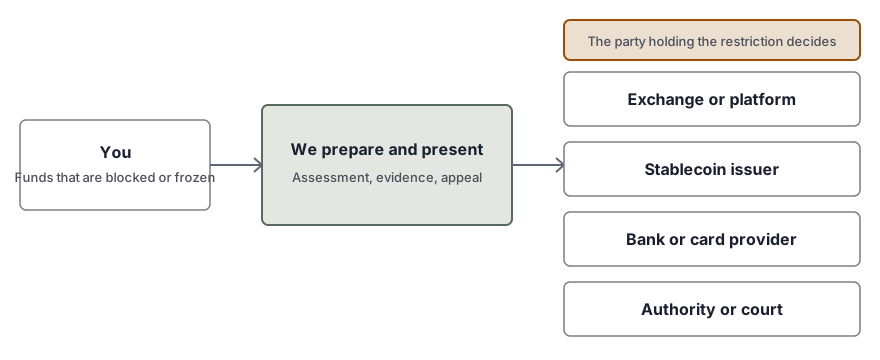
Common restrictions
| Type of restriction | What it means |
|---|---|
| Address frozen under a legal order | Among the reasons Circle gives for blocking an address are compliance with laws and valid legal orders from a recognised authority or court. The block comes off only after that authority confirms the order no longer applies. |
| When a government request puts a hold on your address | Circle notes it may respond to certain urgent requests from governments. The article gives no details on how such requests are handled, so the way forward runs through the authority itself, not through you as the holder. |
| Taking steps regarding a security block | Circle says it can block an address when it judges, at its own discretion, that this is needed to protect the security or reliability of its network. That block may be lifted once the incident no longer calls for it. |
| Money held at a frozen address | Money sent to or received from a blocked address can fail to go through, and while the block stands the funds stay out of reach. Circle explains that a block does not undo a transfer. |
What you can do, one step at a time
- Check whether the address is really blocked
There are other reasons a transfer can fail. Look closely at the transaction details, and ask your wallet provider or exchange if the error suggests a block on the address itself.
- Learn the reason behind it
Whoever told you about the block, whether a platform or an authority, can tell you what caused it. Circle's article names legal orders, government requests and security issues as the usual grounds.
- Gather proof of ownership and where funds came from
Put together evidence that you control the address, plus records showing the origin of the funds. Any party you deal with will want to see this.
- Bring in a lawyer when an order is involved
According to the article, a block exists to meet legal duties or orders, and it is lifted once an authority confirms those no longer apply. A lawyer can reach out to that authority on your behalf.
- Tell the police about the theft, first
When money moves without your consent, Circle suggests you get in touch with local police promptly, bringing the addresses, hash, date, time and amount.
- Contact Circle support only on their official pages
A contact route is available on Circle's help page. Get there via circle.com, and skip any link that arrives in a message from someone you don't know.
What to have ready
- The blocked address, and the token's name in plain text
- Transaction hashes, along with the dates, times and amounts
- Proof showing the address is under your control
- Records tracing where the money originally came from
- Whatever notice or order a platform or authority sent you
- A police report number, in case funds moved without your consent
Pitfalls and scams to stay away from
- Never give anyone your seed phrase, private keys or passwords, no matter who claims they can get your address off a blocklist.
- Pay no one who promises fast removal. Removal, as the article explains, depends on an authority or a closed security incident. It is not something you can buy.
- Never connect your crypto wallet to any website asking you to check or unlock an address. These sites pose risks that could drain your funds.
- Watch out for unsolicited messages about recovering stolen USDC. Circle states that a completed transfer cannot be reversed or recalled.
When outside help is worth it
- A legal order or investigation appears to be behind the block
- A large balance is stuck, and it is unclear who holds the restriction
- Gather and organize clear proof of control and origin for any lawyer or authority.
- Funds were stolen, and the facts need to be documented quickly for the police
Questions people ask
Why might Circle block my USDC address?
Circle's help article names three reasons it may freeze an address: legal compliance, valid legal orders, and urgent government requests it must follow. It can also act on its own judgment about a security threat. The article does not explain how any one address gets selected. This is the part we cannot change, but we can work with what is listed.
Can Circle ever undo a USDC transfer?
We understand this is frustrating. Circle states that USDC and EURC transfers are irreversible. Once a transfer is completed, Circle cannot recall or reverse it. Blocklisting simply stops an address from sending or getting funds.
Is it possible for a blocked address to become active again?
Circle might remove a restriction when an authority confirms a legal obligation is lifted. This can also happen if a security incident ends and no longer requires the restriction.
My USDC has been stolen. What is my next small step?
Contact your local law enforcement right away. Provide them with the transaction details: the hash, dates, times, and addresses. Law enforcement can then use legal process to communicate with Circle.
Does Circle provide a specific appeal form for blocked accounts?
While there is no dedicated appeal form mentioned, the help article covers the conditions for removal. If the block is related to a legal order, the proper route is through a lawyer and the relevant authority.
Is Circle obligated to notify me when my account is blocked?
The help article does not promise notification. If your platform sent you a block notice, ask for details. Specifically, ask what notice they received and who provided it.
Is this page run by Circle?
No, it is not. We work separately from Circle, with no connection to them. What we do is go through Circle's own pages, share links to them, and we have no way to affect any decision made about an address.
Related services
- Appealing a stablecoin freeze. Build a documented appeal for Tether, Circle or another stablecoin issuer.
- Unblocking a frozen crypto wallet. We prepare and present cases for frozen or flagged wallets, from USD 50,000.
- Tracing stolen crypto and requesting freezes. Follow stolen crypto, ask exchanges and issuers to freeze it, and file a police report.
Read next
Official pages read
These are the official or authoritative pages behind this page. Sources get updated over time, so check them for the current wording.
- Understand Circle's stablecoin blocklisting process · Circle
- Announcing USDC v2.2 · Circle
This page gives general information only. It is not legal advice.