
When Tether (USDT) is frozen or blacklisted at your address: what the official pages tell us
Published: Official pages last read: How we edit
Tether's terms state it may freeze tokens where the law requires it or where it judges it prudent, and may blacklist an address tied to suspected prohibited use. It says governments, law enforcement and courts send it requests. The pages we read describe no appeal procedure. Matters like thefts, hacks and scams go to its information requests team, so collect your evidence first and steer clear of anyone selling an unfreeze.
We have no connection to Tether (USDT). We are a separate service, we cannot sway its decisions, and nothing here comes from Tether (USDT) officially.
Not sure what to do next? Write to us:
What the platform's own pages say
- According to Tether's terms, the company and its affiliates can get requests for information from courts, governments and law enforcement, and may pass along personal data when a legal order requires it or when sharing seems reasonable and necessary. [1]
- The terms say Tether may freeze tokens when applicable law requires it or when it decides that is prudent, and may suspend access at a government's direction or when a wallet faces pending litigation, investigation or government proceedings. [1]
- If use is suspected of being prohibited, the platform can freeze funds or blacklist any address holding Tether tokens. We must also mention that reports to authorities may be made without prior notice to the user. [1]
- Under the terms, Tether is required to report to agencies like FinCEN and OFAC. The terms are silent on when an address gets blacklisted, how to request it, which documents apply, or any appeal route. [1]
- Questions about prohibited uses go to the Tether customer support site named in the terms. [1]
- On Tether's own recovery page, it states that legal problems tied to law enforcement requests, thefts, hacks, scams, or related issues should go to the Tether information requests team. [2]
- On the recovery page for tokens sent by mistake to unsupported destinations, the platform states that cases are reviewed first and that recovery happens at its discretion. It may also be refused, and no outcome can be promised. [2]
- The platform's page says that for these optional recoveries, the fee can be up to 10% of what is recovered, or at least 1,000 dollars. The fee depends on which amount is higher. The user must be verified first. Cases may take several months. [2]
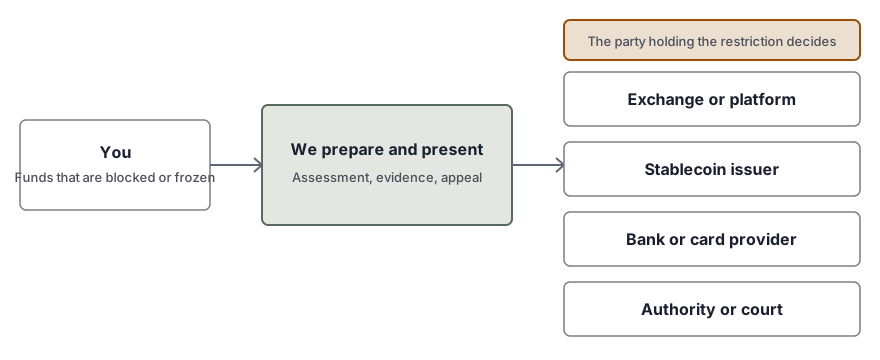
Common restrictions
| Type of restriction | What it means |
|---|---|
| Address frozen | Under the terms, Tether can blacklist an address holding its tokens when prohibited use is suspected. The criteria behind this, and how an address gets reviewed, are not spelled out in those terms. |
| When the law requires a freeze | Tether may freeze your tokens to meet legal obligations. They respond to requests from government bodies and courts. It is possible you will not receive a specific notice. This is the part we cannot change. |
| Paused while things move forward | Tether can freeze a wallet if a government tells them to, or if the wallet is part of a court case or an investigation. |
| Funds went to an unintended crypto destination | When your USDT is on a blacklisted address, that is not the same as a freeze. The process for mistaken transfers is handled case by case. There is a fee, no set timeline, and no result is promised. This page explains how that works. |
What you can do, one step at a time
- Work out which problem you are facing
When an address is frozen or blacklisted, when tokens go to the wrong place, or when funds are stolen, each problem has its own path forward. First, take a breath and write down which one you are dealing with.
- Write down the facts in plain text
Write down the address, the token, each transaction hash, the dates and the amounts. The recovery page needs addresses and hashes as typed text, not just in screenshots.
- See who set the freeze
Check with your exchange or custodian first. Find out if the block is on your account with them or on the actual address. A lot of issues happen at the platform level, not at the issuer level.
- Go through Tether's official legal channels
Tether's recovery page directs law enforcement cases, theft, hacks and scams to its information requests team. Those pages do not mention an appeal form, so it is safest not to count on one being there.
- Talk to the receiving party first
On the recovery page, the guidance is to ask whoever received the tokens by mistake to send them back before you reach out to Tether. That route can be faster. Start there, with one polite message.
- Tell the police and save your records
If your tokens were stolen, file a report with the police and write down the report number. Tether's own pages say it handles requests that come from authorities, not from private individuals. So the report matters.
What to have ready
- The address involved, plus the token, written out in text
- Transaction hashes, dates and amounts for each transfer that matters
- Proof that the address is yours, like a signed message or records from an exchange
- Documents showing where the funds came from, such as purchase receipts or bank records
- Notices that arrive from a platform or from an authority
- A report number from police or fraud authorities, if the funds were stolen
Pitfalls and scams to stay away from
- Don't share your seed phrase, private keys, or passwords with anyone offering to unfreeze USDT. Do not connect your wallet to any site that promises to remove a blacklist.
- Be cautious of individuals claiming to have private access inside Tether. Only authorized personnel can lift a blacklist on demand.
- Do not pay any service in advance that promises to unfreeze your address. Tether’s official pages do not describe any such third-party route.
- Avoid moving remaining funds through unknown services to prevent a freeze. New transfers can create more activity, which requires further explanation.
When outside help is worth it
- It appears the freeze is due to an ongoing investigation or an order from an authority.
- Your large balance may be blocked, and the platform cannot say who holds the restriction.
- You may need a report documenting the origin of funds for a lawyer or a platform.
- If you were hacked or scammed, you need evidence organized for law enforcement.
Questions people ask
Can Tether freeze my USDT?
Tether's terms state that they may freeze tokens if required by law or where they find it appropriate. They can also blacklist an address linked to prohibited use. Furthermore, their terms confirm they receive requests from courts, law enforcement, and governments.
Can you appeal a freeze by Tether?
We checked the public pages, and none of them describe an appeal or request route for addresses that are frozen or blacklisted. What they do say is that thefts, hacks, scams and law enforcement requests belong with the information requests team. For now, the small step is simple: ask a lawyer how to proceed.
Does Tether notify you before freezing an address?
This one can catch you off guard, so it helps to know how it works. The terms state that reports to authorities may happen without notice to the user. No warning before a freeze is promised, so the first sign may be a transfer that fails. Check the terms today so you know what to expect.
What should I do if USDT went to the wrong address?
Tether's site suggests you first reach out to the person who received your funds. It explains a case-by-step review with a fee, up to 10% or 1,000 dollars, and no guaranteed result.
Can an exchange lift a freeze on my USDT?
An exchange can remove a restriction placed on your account with it. What it cannot do is clear an issuer-level blacklist. So begin with one small step: ask the exchange whether the limit sits on your account or on the address itself.
Will a paid recovery service unfreeze USDT for me?
This is a moment to go slowly. Tether's own materials do not list any outside path for this problem. Offers that come to you without asking, promising to fix a frozen address, are often scams. Keep your private keys to yourself. Do not send any money ahead of work.
Is this page run by Tether?
No. Tether does not own or run this page, and we have no connection to them. We pull together what Tether says on its own pages, link you there, and we have no way to sway any decision about an address.
Related services
- Appealing a stablecoin freeze. Build a documented appeal for Tether, Circle or another stablecoin issuer.
- Unblocking a frozen crypto wallet. We prepare and present cases for frozen or flagged wallets, from USD 50,000.
- Tracing stolen crypto and requesting freezes. Follow stolen crypto, ask exchanges and issuers to freeze it, and file a police report.
Read next
Official pages read
These are the official or authoritative pages behind this page. Sources get updated over time, so check them for the current wording.
- Tether legal terms, law enforcement requests tab · Tether
- Tether tokens Recovery · Tether
This page gives general information only. It is not legal advice.