
Flagged by mistake as sanctioned or high risk: steps to dispute it
Published: Last reviewed: How we edit
Screening tools sometimes flag your name, address or a counterparty by mistake, and that mistake is a false positive. It happens often when names are shared or the exposure is only indirect. To clear it, you need evidence showing you are not the listed person or party, and this usually goes through a lawyer. We help prepare that evidence and coordinate independent licensed lawyers. If the match turns out to be genuine, we cannot help you avoid it.
Not sure what to do next? Write to us:
Everyday situations
- A shared name paired with a listed person's birth year or country
- A home or company address near a listed party, or in a higher-risk region
- Incoming funds traced a few hops back to a service later put on a list
- A partner or customer matched to a list entry describing another company
- A wallet flagged by analytics tools, with no plain reason given for the exposure
- Your account held while compliance waits on a legal review of the match
This fits if you
- Your name looks like someone on a sanctions list, and your account is now frozen
- An exchange or bank has flagged the person or address you traded with as sanctioned or high risk
- Money moved through a service that was listed later, and you got it without knowing
- A screening system flagged your wallet with a risk label that seems wrong to you
- The account was shut down for compliance reasons, and that was all the explanation you were given
How the case runs
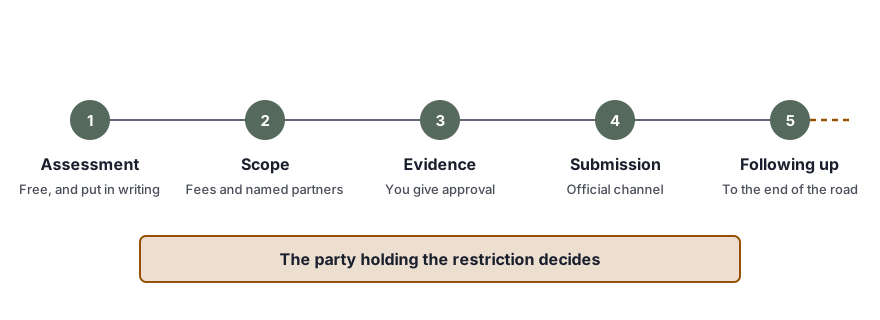
- No-cost evaluation
Tell us about the flag and send us the notices you received. In writing, we will say if it appears to be a false positive, if we can assist, and what proof we would need from you.
- Scope and fee in writing
If we move ahead, you get the scope, our fee model, and the independent lawyer's terms in writing. That comes before any payment from you.
- Gathering Your Documentation
You send documents through a secure channel. We check them for gaps, and for anything that clashes with the listed entry, before the lawyer sees them.
- Submitting to your lawyer
The independent lawyer drafts the statement or request and sends it through the right channel. You get copies, along with the reference numbers.
- Following up
We follow the replies, help you answer follow-up questions, and tell you plainly if the match is real or if the route has reached its end.
What we do
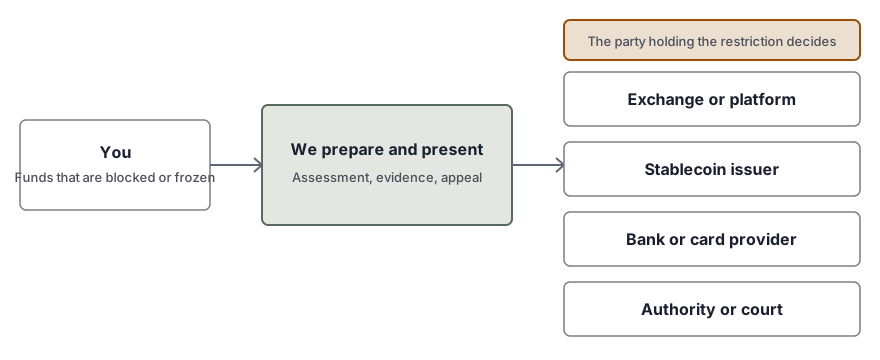
- Find out what was actually matched
The flag can sit on you, an address, a counterparty, or a path of transactions. Each one has its own fix, so first we write down exactly what was matched, plus the list or category the provider used. That record shapes every next small step.
- Tell a false positive apart from a real match
Next, we set your details side by side with the listed entry: name spellings, dates, places, identifiers, roles. If the evidence points to a genuine match, we will say so plainly and go no further. You deserve the honest answer, not a comfortable one.
- Put together the evidence pack
First, we gather what you have: ID, proof of where you live, company papers, the story of your funds, and anything showing you had no connection to the listed party. Everything gets set out in plain order so a lawyer can pick it up and work with it.
- Brief the independent lawyers
Independent licensed lawyers make the legal filings themselves, not our team. Our part is this: we organize the facts and exhibits, settle the scope together with you and the lawyer, and keep the whole file in order.
- Stay on top of the follow-up with the provider
Next, we help you respond when the compliance team asks more questions, keep track of the ticket, and hold on to a clear record of it all. If a regulator or listing authority offers a review route, that call belongs to the lawyer.
What to have ready
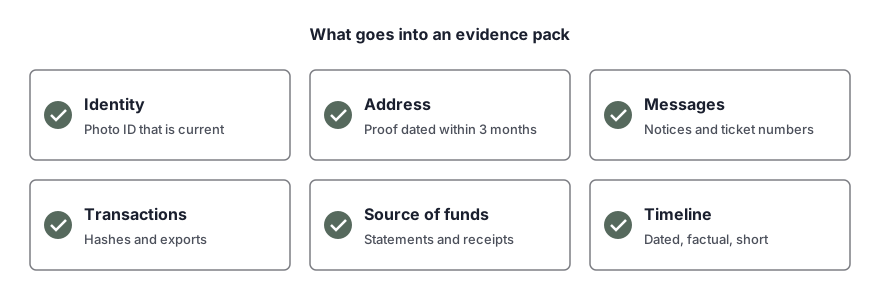
- Passport or national ID with your full name, birth date and birthplace
- Proof of address, plus registration papers and ownership structure if a company is involved
- The provider's notice naming the flag, including dates and reference numbers
- Transaction history covering the wallets or accounts concerned
- Records showing where the flagged funds came from
- Any screening result or clearance you already have on hand
- A brief written note from you saying why the person or party listed is not you
What we cannot do
- Here we are firm: we do not help anyone get around real sanctions. If the match turns out to be genuine, we tell you plainly and we stop there.
- This part is out of our hands: no one can make a provider, regulator or listing authority clear a flag. That choice is theirs, and some take their time.
- Any legal filings come from independent, licensed lawyers. Our role is gathering evidence and keeping things coordinated. We do not offer legal advice ourselves.
- Your seed phrase, private keys and passwords stay private. We do not ask for any of them.
Questions people ask
What does a sanctions false positive actually mean?
It means the system matched the wrong person. Screening tools run names, addresses and wallet details against watchlists and risk categories. When the information looks close but is not actually yours, an innocent account holder can get flagged. A person is meant to review and clear these matches, yet that review is not always quick.
How do I know whether a match is false or real?
Set your own details next to the listed entry: full name, date of birth, place, identifiers and role. If they do not line up, it is probably a false positive. If they do match, treat it as genuine. Stop moving the funds and wait for a lawyer to advise you.
Do you still assist when the flag turns out to be true?
No. We do not assist with dodging or evading real sanctions. When the assessment confirms the flag is correct, we tell you in writing and end the case. Honest early advice protects you from making it worse.
Why does a lawyer have to be involved here?
Asking for a flag to be removed or a listing to be challenged is a legal filing with legal consequences, so an independent licensed lawyer should make it. Our role is to prepare the evidence and coordinate, giving the lawyer a clean file to work from.
Can a wallet get flagged when I have done nothing wrong?
Yes, it can. A wallet may take in funds that earlier passed through a listed service, several transfers back. Analytics tools can score that kind of exposure as risky. Exposure is not guilt, but you will usually need to explain where the funds came from.
While the case is open, should I transfer the funds somewhere else?
Please don't. Shifting flagged funds can look like hiding them and may make the case harder to resolve. Pause all activity on the flagged account, save every message, and wait for the lawyer's advice.
How long it takes
Clearing a false positive with the provider itself often takes days to weeks. A formal review in front of an authority can stretch over months. Once the assessment is done, we give you an estimate in plain terms, and we update it as the case moves along.
Fees
The assessment costs nothing. If we go further, you first receive a written scope and fee model, including the independent lawyer's fees, so you know the full picture before committing anything. We do not ask for payment before telling you whether we can help at all. Fees →
Related situations
- Disputing wallet risk flags and screening results. Flagged as high risk by a screening tool: trace the funds and dispute the label.
- Packs for source of funds and wealth. We can help you compile clear documentation showing your source of funds and wealth for banks and exchanges.
- Getting an exchange account unblocked. Learn what the exchange is asking, gather KYC and AML evidence, then answer and appeal.
- When authorities freeze your crypto. Your crypto is held by authorities. We connect you with independent lawyers. We cannot give legal advice.
Read next
Sources
These are the official or authoritative pages behind this page. Sources get updated over time, so check them for the current wording.
- Does Coinbase freeze accounts? · Coinbase
This page gives general information only. It is not legal advice.