
How blockchain tracing works: what a trace can show, and where it stops
Published: Last reviewed: How we edit
Blockchain tracing follows transfers on a public ledger, one address to the next. Analysts group addresses that likely belong to one owner, label known services, and watch for the point where funds reach an exchange or another service that holds customer identities. A trace can show where the money went. On its own, it cannot prove who someone is, and it cannot bring the money back.
Not sure what to do next? Write to us:
A public ledger shows movement, not names
Most major blockchains write every transfer into a public ledger. Anyone can check that one address sent a given amount to another address at a given time. Creating an address requires no name from anyone.
Here is the basic idea: the ledger is public, but names are not attached to it. Every movement of funds is visible in fine detail. What the ledger never shows is who stands behind each address. Tracing exists to bridge that gap, and it only gets as far as the evidence actually goes.
How analysts follow the funds
The basic step is to follow the outputs. From a known address, the analyst looks at where funds moved next, and then where they moved after that. Software draws each hop as a graph, so even a long chain can be read at a glance.
Analysts' tools also log timing, amounts and patterns. For example, a quick run of transfers in split amounts might point to an attempt to conceal the route. The analyst writes these patterns down, but never treats them as proof.
- Trace each transfer from the first address to the addresses that follow it.
- Write down amounts, timestamps and which networks were used, cross chain bridges included.
- Flag known services: exchanges, payment processors and smart contracts.
- Note where the trail stops or grows unclear, and the reason why.
How addresses get grouped and labeled
Clustering puts addresses that likely share one owner into a group. The groupings rest on heuristics: several addresses signing a single transaction as inputs, or a change address used again and again. These are informed guesses, not certainties.
Labels give clusters names, such as an exchange, a gambling site or a known scam wallet. The names come from public sources, from direct knowledge of services and from reports. A label can be wrong or stale, and that is why a careful report says how confident it is.
Where mixers, bridges and other obstacles come in
Mixers combine funds from many users and send them out in fresh amounts, so the direct link between what went in and what came out is broken. Cross chain bridges and swaps shift value onto another network, where the trail has to be picked up from scratch. Privacy focused coins and chain hopping add further steps.
A mixer does not always stop a trace. From timing and amounts, analysts can still estimate which links fit together. Still, a result past a mixer is usually a probability rather than a fact, and a proper report should state that plainly.
Where exchanges act as exit points
Regulated exchanges, and many other services, ask customers for identity documents. If stolen or disputed funds land on a deposit address at one of them, that service is the one holding records of who controls the account. That is the reason exit points matter so much.
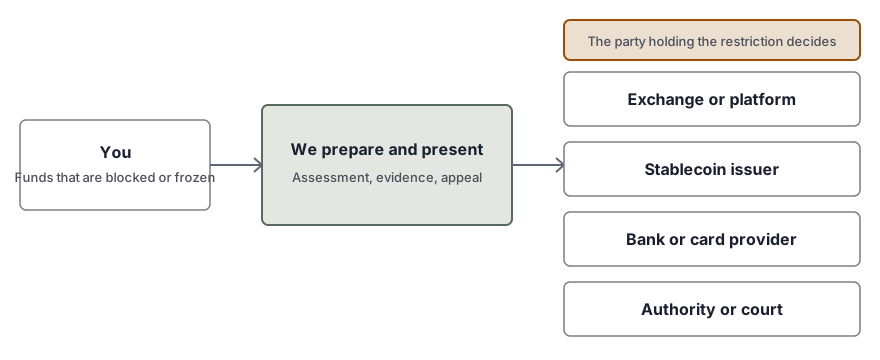
A trace can identify the service involved. What happens next is up to that service, once a police report, a court order or a valid request arrives. It might freeze the account, request evidence, or refuse. Here is the part we cannot change: no one can force an exchange to act.
What a trace shows, and what it does not
A careful trace can map the route your funds took, each point where they changed hands, the services they passed through, and how long it all took. That map can back up a police report, or a request to an exchange or an issuer.
It cannot tell you who a person is, why a transfer was made, or that every link in the chain is certain. And it cannot pull a transfer back. If your case needs a trace, an independent analyst can write the report. We can help you set out the request and bring it to the right party.
Questions people ask
Can other people trace my crypto transactions?
The public ledger is open to anyone, so transfers on those chains can be seen by all. Connecting an address to an actual person, though, calls for extra information, like exchange records or other data. A casual viewer only sees addresses, never names.
Can a trace uncover who the scammer is?
On its own, no. Tracing can point to an exchange or another service that keeps identity records. Getting those records is up to police or a court, who must request them from that service. What comes back depends on the service and the law in play.
Does a mixer make funds impossible to trace?
Mixing makes a trail harder to follow and the outcome less certain, yet it does not always stop the work. By looking at timing and amounts, analysts can sometimes estimate likely links. Those findings are probabilities, so a report should state how dependable each one is.
How reliable are address labels?
They help, but they are not flawless. Labels come from several sources, and some may be old or incorrect. A careful analyst checks key labels against more than one source and states the level of confidence.
Can a tracing report get my funds back?
No. Think of a report as evidence, not a decision. It can back up a request you send to an exchange, an issuer, or the police. What happens next is up to them, and that is the part we cannot change. Nobody can promise your funds will come back.
How we can help
- Reading a blockchain analytics report. A traced source-of-funds report, written for a compliance team to use.
- Tracing stolen crypto and requesting freezes. Follow stolen crypto, ask exchanges and issuers to freeze it, and file a police report.
- DeFi exploit and bridge hack help. Following a DeFi exploit or bridge hack. We help with tracing, alerts and reporting.
- Disputing wallet risk flags and screening results. Flagged as high risk by a screening tool: trace the funds and dispute the label.
This page gives general information only. It is not legal advice.