
What determines the wait and how long an exchange compliance review lasts.
Published: Last reviewed: How we edit
We cannot give you one set timeline because the duration varies greatly. Many different factors affect the review process. We consider the reason for the review, the completeness of your answers, and the team's current workload. For example, Kraken states reviews often take 10 to 14 business days. Coinbase mentions restrictions can take up to 10 business days to resolve, though we know some cases take extra time.
Not sure what to do next? Write to us:
Timing according to the official help pages
Most exchanges never publish a deadline for their compliance review, and no exchange can commit to one. A couple of help pages do offer a rough range, and those figures are the only timing numbers here. Treat them as a guide to what counts as typical. Then check the live page your own exchange shows today, since help pages get rewritten.
The Coinbase figure appears on a page about restrictions that Coinbase ties to security concerns, for example suspected malicious activity. It may not cover every type of review. The Kraken page describes a broader set of temporary restrictions, including legal and regulatory requirements. Both pages note that some cases fall outside the usual range and take longer.
None of the platform help pages we used for this site share a typical review length. Some mention a deadline for one small step, like one type of appeal, but that does not apply to a full compliance review. Write down the date your restriction started, so you will know when any stated range has passed.
| Platform | What the help page says about timing | What that page covers |
|---|---|---|
| Kraken | A review normally runs 10 to 14 business days, and busy periods can stretch it further. | Temporary holds, for instance after unusual activity, ID details that are out of date, a reversed payment, or a legal obligation. |
| Coinbase | Sorting out a restriction and finishing the review usually takes up to 10 business days, though some cases can run longer. | Account restrictions the page ties to security concerns. Coinbase notes it sends you an email once the review is done. |
| Other platforms | The pages we checked do not list a standard review length. | Only a handful give a time, and just for one narrow step, like a single appeal type. |
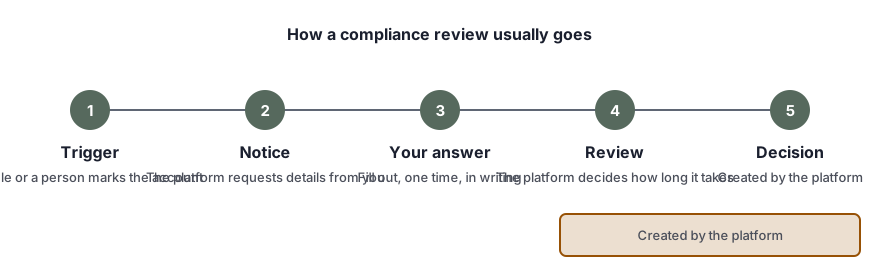
What decides how long your review lasts
Two accounts in review can sit in line for very different stretches of time. Part of what causes the delay sits outside your hands. The rest does not, so begin with the answer you submit and the documents that support it.
- What triggered it. Refreshing a basic identity check is usually a lighter task than explaining the source of a big deposit.
- How fully you answer each question matters. If pages are missing, scans are blurry, or questions are left blank, the file comes back to you. Kraken's help page notes that incomplete responses can mean several extra days.
- Do your files match each other? If a name, date or amount differs from one document to the next, that opens fresh questions.
- How much work the team is handling. According to Kraken's help page, a review may take more time during busy periods.
- Whether another party is part of the picture. When a court order or a request from an authority sits behind the freeze, the exchange may need to wait on that body.
- We look closely at the transaction details you provide. A clear, brief history helps greatly. This is quicker than trying to check years of activity across many different wallets and platforms.
How a review unfolds, and who is waiting on whom
Each exchange words its process differently, so read this as a broad pattern rather than one platform's exact procedure. Nearly all reviews move through similar steps. And the slowest stretches are usually the ones where the exchange is waiting on you.
Use the table to find where your case likely sits. If the ball is in your court, take that step first. If the exchange holds it, give them the stated range before checking back in.
| Stage | What typically happens | Who is waiting | What you can do |
|---|---|---|---|
| Notice | The account gets limited. A notice or banner gives the reason in broad terms, or just points to a category. | You are the one waiting for clarity | Read it carefully, write down the deadline and the channel, and keep a saved copy. |
| Request for information | The exchange wants identity documents, proof of your address, or proof of where the funds came from. | The exchange is waiting on you | Send one complete reply through the channel named in the notice, and save the reference number. |
| Document check | A reviewer, or an automated check, compares what you sent against what the account shows. | You are waiting on the exchange | Hold for the stated range, and avoid any new transfers that would create more activity to explain. |
| Follow-up questions | The reviewer might come back asking for a page that was missing, a cleaner scan, or a brief explanation. | The exchange is waiting on you | Reply in the same thread, answering only what was asked, as soon as you reasonably can. |
| Decision | The restriction may be lifted, narrowed or left in place, or the account may be closed. | You are waiting on the exchange | Read the outcome carefully. If the restriction remains, ask what information is still missing. |
| Appeal or escalation | A second review is offered by some exchanges. Others publish no appeal route at all. | Depends on the exchange | Follow the route named in the notice, and before writing again, ask for the specific reason. |
Why some reviews take longer
Most holdups trace back to the same handful of slip-ups. On its help page, Kraken advises customers to reply to every question at once, using documents that are clear and current, and it cautions that half-done answers can stretch the wait by days. Any exchange will tell you the same. Before you hit send, run your reply against the list below.
- Documents drip-fed across several days, so the reviewer never sees one whole file.
- Scans that are blurry, cut off, or past their date, or names that do not match across papers.
- Answering something the exchange never asked, while skipping the question it did ask.
- Starting several tickets for one case, which can split replies across separate threads.
- Shifting funds while the review is open, creating fresh activity you then have to explain.
- Hostile or threatening messages. They add pages for someone to read, not facts.
- A legal order behind the hold. Until the authority acts, the exchange may have no way to close it out.
What to do while waiting
Keep calm and take small steps while you wait for your reply. A simple routine keeps your information clean for whatever comes next.
- First, write down the key dates for you. Record when the restriction began, when you sent a reply, and your reference number.
- Next, check your email, including the spam folder, and the exchange app for messages. Kraken says they send both an email and an in-app notice if they need more, and many reviews conclude without extra requests.
- Keep every piece of correspondence you receive. Save all the files you sent, and make sure to record the dates.
- Do not move your funds or try to open a new account to bypass the review. If the exchange states you can withdraw, follow their exact instructions.
- If there is any chance another person used your account, do what the exchange's own security page asks. On Kraken, that means resetting your password, removing devices you don't recognize, and reviewing your two-factor authentication settings.
- Once the stated time period has passed, follow up only one time in the original thread. Quote your reference number and ask one specific question. Kraken suggests contacting chat support if there is no reply after 14 business days.
- If someone reaches out first and says they can speed up the review for a fee, ignore them. Never give a seed phrase, private key or password to anyone.
When waiting on its own stops being enough
Some signs mean your case needs more than patience right now. Look for these signs: the stated time has passed with no response, the same documents are repeatedly requested, the notice names a legal request, or a large sum is involved.
If that happens, write to the exchange in the same thread and ask plainly which document or detail is still missing. Where the exchange is regulated and such a route exists, a complaint to its regulator or ombudsman may be possible. A specialist can also go through your file for gaps and draft a clear reply.
This check is available at the free assessment stage. We confirm in writing, before any fee is mentioned, whether we can help. We cannot hurry the exchange or decide for it, and we will never ask for a seed phrase, private key or password. If your review has gone past the stated range, start with the free assessment.
Questions people ask
Can anything make an exchange compliance review move faster?
Not by direct pressure. The exchange sets its own pace, and no one can force a decision from outside. What sits with you is the quality of what you send: one complete package, consistent documents, and the exact channel the exchange named. Doing that removes the most common reasons for delay.
What happens if the review runs longer than the help page states?
The help pages cover typical cases, and the two we checked both leave room for reviews that run longer. If the stated range has already gone by, send one follow-up in the same thread. Quote your reference number and ask plainly what is still missing from your file. Then keep every reply you receive, so nothing gets lost if the case is passed to someone new.
If the review takes a long time, does the exchange think I committed a crime?
Usually not. A longer wait often means the exchange needs a document, a second check, or something from an outside body. A request coming from a court or an authority is a separate matter, and the notice would normally say so plainly.
Do exchanges all publish how long a review takes?
We looked through many help pages for this site. For now, only Kraken and Coinbase offered a general time frame. The other exchanges list steps without timing. They might also give time for only one small part. To find the most current details, please read your specific exchange page.
Should I resend my paperwork if the exchange goes quiet?
Usually no. Wait until the exchange asks. Sending a fresh copy can split your case between two threads, which slows things down. Instead, reply in the original thread, include your reference number, and ask two plain questions: did the documents arrive, and is anything still missing?
How we can help
- Getting an exchange account unblocked. Learn what the exchange is asking, gather KYC and AML evidence, then answer and appeal.
- Find out who froze your crypto. Learn who is behind the freeze and which next steps are realistic.
- Packs for source of funds and wealth. We can help you compile clear documentation showing your source of funds and wealth for banks and exchanges.
- Regulator and ombudsman complaints for crypto issues. Organize a clear timeline for your complaint to a regulator, ombudsman, or consumer agency.
Sources
These are the official or authoritative pages behind this page. Sources get updated over time, so check them for the current wording.
- Why is my account restricted? · Kraken
- Resolve your account restriction · Coinbase
This page gives general information only. It is not legal advice.