
Writing an Effective Crypto Exchange Appeal: Structure, Tone, and Required Documents
Published: Last reviewed: How we edit
This is overwhelming, but a solid appeal can be managed. First, state who you are and which account is restricted. Next, explain the restriction and its date. Respond only to the exchange's specific questions. Attach documents showing where the funds came from. Then, make one clear request. Use official channels, save your reference number, and stay away from threats or guesses.
Not sure what to do next? Write to us:
First, Let’s See What the Exchange Needs to Know
Not every notification about a restriction means you can file an appeal. Some messages simply request specific documents. Other notices are just reporting a final decision. Please read the notice very carefully, then decide which of these situations you are in.
If the notice asks a specific question, answer only that and nothing more. If it is reporting a decision you believe is incorrect, you should write an appeal. If the exchange provides its own form, use that first. Use the structure below for any open text fields.
Certain exchanges state they may not share the precise reason for a restriction. Kraken's help page indicates this. If you cannot see a reason, do not guess it. Instead, ask which information is needed to complete your review. Begin by copying the exact words of their request into your personal notes.
A Plain Template You Can Adjust
Keep the same order every time. A reviewer goes through many files, and a familiar layout lets them find your facts, your documents and your request within seconds. The skeleton below is generic. Swap each description for your own facts, and leave out anything you cannot back up.
Our free appeal letter builder is at /tools/appeal-letter/. It takes the facts you enter and puts them in the right order. Everything stays in your browser. Nothing is saved. You get only what you type. You can copy the letter or save it as a text file. Or you can use the structure and write it yourself.
| Part | What goes there |
|---|---|
| Subject line | Say what you are writing about, and include your case reference if one exists, for instance: asking for a second look at an account restriction. |
| Who you are | Your full name exactly as it appears on the account, plus the account email or ID if the platform assigns one. |
| The restriction | Which access is limited (login, withdrawals, trading or the full account) and the date the limit started. |
| What you were told | What the exchange told you, written out in plain words, plus the date and any reference number it gave. If you copy their message, copy it exactly. |
| Where the funds came from | Where the money came from, described in plain facts, for example wages, a sale of an asset or earlier trading, plus the names of the papers that back this up. |
| Documents attached | Each file by name, plus the question it answers. |
| What you ask for | Make one plain ask, such as: please review this freeze, or let me know exactly what details you still need and when you need them by. |
| Close | Ask for a case number and the step that comes next, give your name, and include one contact detail the platform already has on file. |
Tone: calm, specific, short
Picture the person on the other side: your file open, limited time. That reader responds well to short sentences, dates and figures. Say which account, which dates, which documents. Skip the adjectives.
Send your first letter in neutral language. Complaints about the exchange, threats of legal action and talk about your feelings give the reviewer nothing to work with, and they push your facts into the background. If you escalate later, you will then have a clean record showing you answered fully in writing. When the draft is done, read it through and remove anything that is not a fact or a request.
- Keep each letter focused on a single ask. A reviewer can handle one clear request far more easily than a whole list of demands.
- Write simply, and stick to whatever language their support team uses.
- Spell out dates completely, for example 12 October 2026, and state each amount with its currency.
- Facts come first, then your request. Leave opinions about the decision out.
- Do not guess why the exchange acted, and leave its staff out of the letter.
- Keep it polite, even when you are frustrated. A courteous letter is easier for someone to act on.
What to include as attachments
Send only the files that answer what they asked for. Every document has to earn its spot, and your letter should say what each one shows. As an example, Kraken's help page asks customers to send clear, current documents and to answer all questions in a single reply, since incomplete answers can add days. Gather these papers before you begin writing.
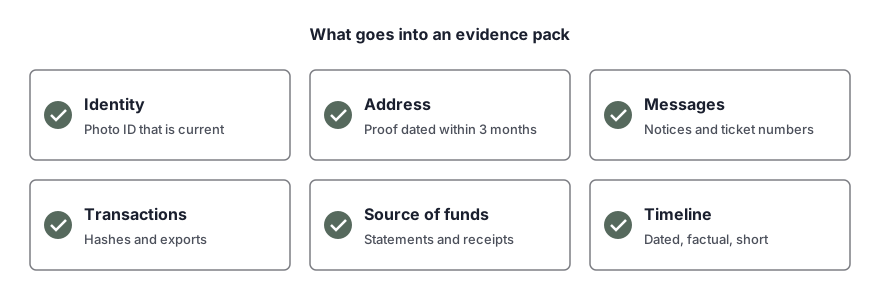
- A photo ID matching the account name, plus proof of address if the notice requests it.
- The exchange's own notice, or a screenshot of the restriction that includes its date.
- Bank statements or receipts showing money moving between you and the exchange, either direction.
- Exports of your past trading history on the exchange, if the funds came from trading.
- The wallet addresses you control, along with a note on how you could prove control if asked.
- A one-page timeline running from your first deposit to the day the restriction appeared.
- A brief cover note listing every file and naming the question it answers.
What to leave out
Keep out anything that brings risk or clutter. Private details you did not need to share will not make your case stronger, and a few of them can quietly sink it. Before sending, run through the draft one time against this list, then one time against the notice.
- Your seed phrase, private keys, passwords, and one-time codes stay private. An appeal should never include them, and you should not share them with anyone who offers to help either.
- Papers you have altered, touched up, or cannot back up. A missing document is simpler to explain than one that has been changed.
- Old arguments, side complaints, and your whole life history. Leave those out.
- Details that belong to someone else, unless the request truly calls for them and that person has agreed.
- Claims about laws or rights you have not verified. One shaky legal statement can spoil a letter that is otherwise clear.
Once it is sent
File the appeal once, and only through the official channel named in the notice. Keep a copy of what you sent, with the date and the reference number you get back. Never hand it to a third party who contacted you first, and never pay someone to deliver it for you.
After that, wait for the review period they gave you. We have a guide that explains how long an exchange compliance review can take, based on what two platforms state. When that time is up, send one follow-up in the same conversation thread. If they say no, ask for the exact reason. Then see if the exchange allows a second review.
When documents come back rejected again and again, when the sum involved is large, or when a regulator could end up hearing a complaint, outside help may be worth considering. Your first assessment with us costs nothing, and before any fee comes up we tell you in writing whether we are able to assist. We have no power to make the exchange rule in your favour, and no one here will ever ask for a seed phrase, private key or password. If you want a second pair of eyes on your draft, just request the assessment.
Questions people ask
We recommend sending a single message. Is one full document better than many small ones?
This is confusing. Write one complete letter. When you send one full message, the reviewer can see everything together. Sending many partial messages separates the facts and may cause confusion about the current situation.
Is it okay to use a template or some form of AI to help me compose my appeal?
Using a template is acceptable for layout. You must own the facts in the letter, and they must match your documents. Do not allow any program to include information like dates or amounts you did not provide. Never put a seed phrase, private key, or password into any tool.
What steps should I take if my appeal is rejected?
First, ask for the specific reason for the rejection and what information might be missing. Check if the platform permits a second review. Compare their response to your documents and address any gaps. If the platform is regulated, you might file a complaint with the ombudsman, depending on the availability of such a route.
Should I name a lawyer or a regulator during my first written appeal?
Only mention them if you are already working with them. Your initial appeal should be a calm statement of facts and a clear request for action. Bringing up a lawyer or regulator without having engaged them may seem like a threat, and it does not provide new evidence.
Is it necessary for me to pay someone to help write my appeal?
Not necessarily. You can draft it yourself, and many people do. Paid assistance may be helpful if the details are complicated or the funds involved are large. Always ask for the full scope and fee in writing before you agree. Consider any offer that reaches you unasked as a warning.
How we can help
- Getting an exchange account unblocked. Learn what the exchange is asking, gather KYC and AML evidence, then answer and appeal.
- Packs for source of funds and wealth. We can help you compile clear documentation showing your source of funds and wealth for banks and exchanges.
- Find out who froze your crypto. Learn who is behind the freeze and which next steps are realistic.
- Regulator and ombudsman complaints for crypto issues. Organize a clear timeline for your complaint to a regulator, ombudsman, or consumer agency.
Sources
These are the official or authoritative pages behind this page. Sources get updated over time, so check them for the current wording.
- Why is my account restricted? · Kraken
This page gives general information only. It is not legal advice.