
Crypto case digital evidence: how to collect, name and sort it for police, exchanges or court
Published: Last reviewed: How we edit
Strong digital evidence is gathered early, stored without changes, and labelled so it shows who collected it, when and how. It should also be arranged so someone unfamiliar with your case can follow it. We help you collect and index chats, screenshots, statements and transaction records, and we coordinate independent forensic specialists when a formal capture is needed. No court, police unit or platform is guaranteed to accept the evidence.
Not sure what to do next? Write to us:
Everyday situations
- A phone gallery full of screenshots, with no dates, order or context
- A conversation with a scammer inside a messenger app that could be banned or deleted
- A fake investment site displaying your balance, one that may disappear any day
- Exchange statements in several languages and formats, with gaps in the dates
- Emails from a platform where the attachments and headers carry weight
- A device someone had remote access to, which now calls for careful handling
- Documents written in another language, needing a translation your lawyer can depend on
This fits if you
- You plan to file a police report, so we will get your screenshots, chats and records organized first
- If you are appealing to an exchange or bank, we help you gather a tidy, organized file of evidence.
- Your lawyer has asked for original files plus a record of how each one was collected
- Scam pages, profiles and chats can vanish, so a proper saved copy matters
- Important messages sit on a phone or laptop, and you are worried about damaging them
How the case runs
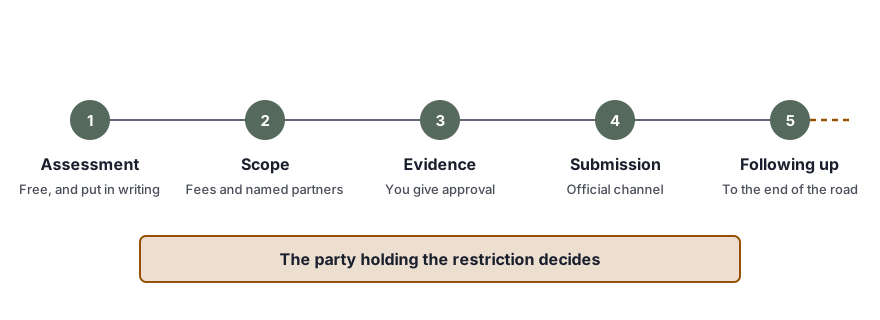
- No-cost evaluation
You tell us about the case and what you hold. In writing, we tell you which items matter most, which could vanish, and whether formal capture seems worth the cost.
- Scope and fee in writing
If you go ahead, you get the scope, the specialists involved and the fee model in writing. Any forensic capture is quoted as its own separate item.
- Gathering and recording
First, you send the items through a secure channel, or capture them yourself using our checklist. We log each item, then flag any gaps, duplicates or conflicts we find.
- Formal capture, when it is needed
When something needs formal capture, independent specialists do that work. They record the method used and the hashes. We then check their output against the scope you gave us.
- Handing it over
Next, you get the indexed pack along with the log, plus a short guide to submitting it. We help you send it and answer any questions the recipient raises.
What we do
- Point out what to keep and what to leave alone
First, we hand you a short checklist in writing. Keep every chat. Leave the phone untouched. Do not change files, and never crop an original. Copies may be adjusted for presentation, but originals stay just as they are.
- Record and log every item
For every item, we write down what it is, its source, who collected it, when, and how. That log is often what turns a screenshot from a mere picture into a record a reviewer can rely on.
- Set up formal capture with independent specialists
Some content may disappear or get disputed. Independent forensic specialists can then capture pages, accounts or devices using documented methods and record file hashes. We brief them, settle the scope together and review their work when it arrives.
- Put the evidence pack in order
We put together a bundle with an index: a timeline, exhibits with numbers, a transaction table, and a brief cover note. Where we add translations or redactions, they are clearly labeled, and the original files stay available.
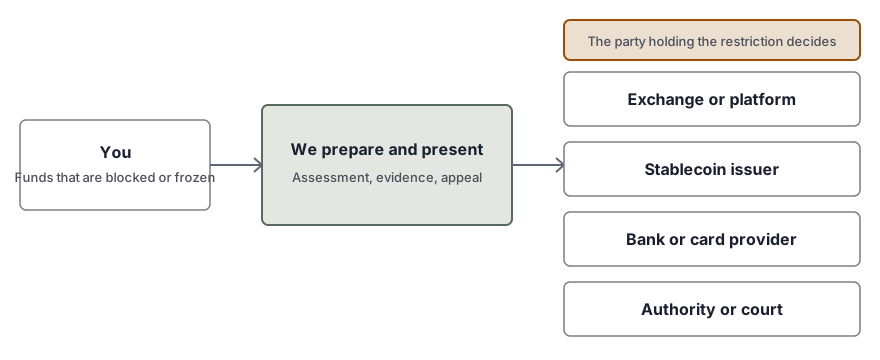
- Match the pack to whoever reads it
A police unit, an exchange compliance team and a court each expect a different format. We tailor the pack to the recipient, cross-check names, dates and amounts, then pass the finished version to you or your lawyer.
What to have ready
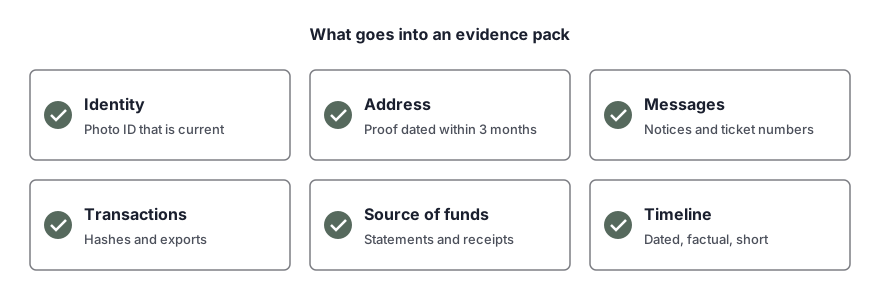
- The original files themselves, like photos, PDFs, emails and chat exports, not just screenshots
- Phone model, app names, usernames and phone numbers you used.
- The URLs of the scam website, the accounts involved, and every page you looked at
- Statements from the exchange, wallet and bank, with dates showing
- Transaction hashes and the wallet addresses
- Numbers from police reports and ticket references from the platform
- A timeline you write yourself
- Translate documents or add notes for foreign language proceedings.
What we cannot do
- It is stressful when evidence is rejected. We cannot require any court, police unit, exchange, or lawyer to accept your materials because rules about admitting material vary by jurisdiction.
- Forensic captures are handled by independent specialists who write their own reports. We do not perform or sign these formal documents for you.
- We do not create, alter, backdate or improve any evidence. When something is missing or damaged, we simply record it.
- We are not lawyers and we do not give legal advice, so your lawyer is the one who decides what has to be disclosed, and in what form.
- We will never request your seed phrase, private keys, or passwords. We do not require remote access to your device or system.
Questions people ask
Does a screenshot hold up as evidence?
This can feel frustrating, but we can address evidence collection now. You should keep original files, including the date, URL, and the person who took the image. Saving the complete chat export is also a necessary small step. For very important information, having a professional specialist capture it will be stronger.
Should I remove the app or wipe my phone?
Please keep your device exactly as it is right now. This can feel overwhelming, but leaving it untouched preserves important data. Deleting apps, resetting the phone, or running cleaning software can destroy critical evidence. If you worry that someone else still has access to your account, tell us immediately before making any changes.
What does chain of custody mean?
This is a written trail showing who had an item, at what time, and what happened to it from the point it was first collected. Its purpose is to demonstrate the item has stayed unchanged since it was captured. Exactly what the rules require, and how much detail is expected, depends on the jurisdiction.
Could you arrange a capture of the scam website?
We can set it up with an independent specialist who records the pages in a documented way, including the date, address and file hashes. Start early, because scam sites vanish quickly. We cannot promise that the capture will be accepted as proof.
Will you have to get into my phone or my accounts?
No. The collection is done by you, following our checklist, or by an independent specialist who acts only with your clear permission and within a written scope. Nobody here will ever ask for your passwords, seed phrases or remote access.
What makes the evidence preparation process different from an expert report?
This work involves gathering and carefully storing digital material. An expert report provides an independent analysis, like tracing money flow. Many cases require both steps. The initial preparation allows the expert analysis to be complete.
How long it takes
Starting the collection can happen the day we get the first items. Creating a tidy pack usually takes days instead of weeks. Formal capture depends on specialist availability and what needs to be taken. We will provide a time estimate once the assessment is finished.
Fees
This is the part we cannot change: we do not charge for the initial assessment. Quotes for organizing a pack and securing forensic specialists are written out separately. You only pay for services you choose. We take no fee before we can tell you if we can help. Fees →
Related situations
- Expert reports for court cases. Experts write the report. We handle coordination, exhibit prep and a clarity check.
- Reading a blockchain analytics report. A traced source-of-funds report, written for a compliance team to use.
- Help after a crypto scam. After a crypto scam: a steady hand to assess, record, follow the money and request freezes.
- Tracing stolen crypto and requesting freezes. Follow stolen crypto, ask exchanges and issuers to freeze it, and file a police report.
Read next
Sources
These are the official or authoritative pages behind this page. Sources get updated over time, so check them for the current wording.
This page gives general information only. It is not legal advice.