
Blockchain expert reports from independent specialists, prepared for court, arbitration and police files
Published: Last reviewed: How we edit
An expert report for court comes from an independent specialist, not from us. That specialist works with your lawyer to answer agreed questions, explain their process, and note any limits. Our role is coordination. We help shape the questions, guide the expert, organize the supporting documents, and review the draft for clear language. A court, tribunal, or police unit may decide not to accept the report. That is a part we cannot control.
Not sure what to do next? Write to us:
Everyday situations
- A lawyer is building a civil claim about stolen crypto and needs to show where the funds went
- A criminal case is open, and investigators ask for a short technical summary to include in the file
- If the other side claims a transfer never left your wallet, or that it never arrived with them
- A token sale, mining or custody contract is in arbitration over where the assets ended up
- A vendor's tracing report is under challenge because the method behind it was never documented
- A court needs a neutral person to explain what actually happens in a blockchain transaction
- The other side has filed an expert report, and your lawyer wants an independent review of it
This fits if you
- If your claim, defence or arbitration rests on blockchain transfers, we prepare the technical report your lawyer asks for
- If a prosecutor or an investigator has asked you for a written analysis of where the money went, and you were the one defrauded, we can help you prepare that document
- A tribunal will ask a company to demonstrate the path of funds across wallets, exchanges and the parties involved
- Disputes often come down to a few plain questions: who held the wallet, when the transfer went through, and where the money finished up
- There is an earlier tracing report on file, but nobody can explain its method to a judge
How the case runs
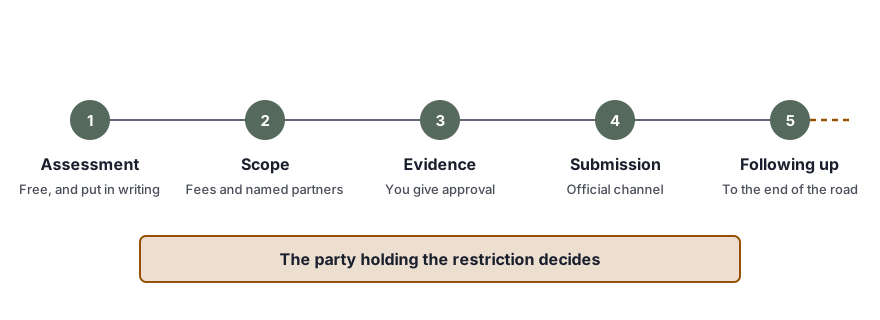
- No-cost evaluation
You tell us the purpose of the report, who requested it, and its due date. We will write down whether an expert report is the right tool, or if a simpler analytics report would be sufficient.
- Scope and fee in writing
If you move forward, you will receive the questions, the proposed expert, their fee basis, and our fee structure in writing. Work begins only after you formally accept these details.
- Briefing and evidence bundle
Your lawyer, or you yourself, gives the expert written instructions. We put together the indexed bundle and respond when the expert asks for records that are still missing.
- Write and check
A draft arrives from the expert. We read it for clarity and check that it matches your documents, then pass any questions back. The expert alone decides what, if anything, to change.
- Last report and what happens next
The expert signs the report and sends the final version to you or your lawyer. We remain available afterwards, for new questions, responses from the other side, and hearing arrangements.
What we do
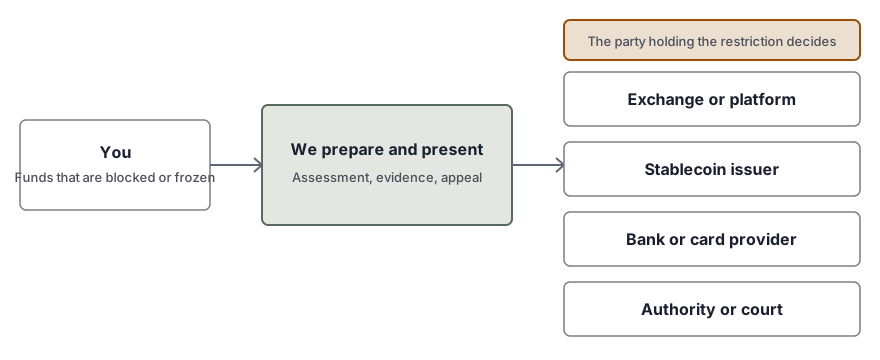
- Settle the key questions with your lawyer, together
This part shapes everything that follows. We help turn the problem into clear questions an expert can actually answer: which transfers, which dates, which addresses. The scope is agreed with your lawyer first, because what an expert is told to do often carries legal weight.
- Choose and instruct your own independent expert
This is overwhelming, and we suggest starting with a careful review. We propose vetting independent blockchain forensic experts by checking their background and conflicts of interest before you make a choice. We provide all necessary facts and documents for review. We do not tell the expert what their conclusion should be.
- Get the documents your expert will use
This step is quiet but it matters. First, we gather your transaction hashes, exchange exports, bank records and screenshots into one indexed bundle. Every item in it notes where it came from and when it was captured. If something is missing, we flag that gap early rather than leave the expert to guess later.
- Check the draft reads clearly
We review the draft through the eyes of a non-technical reader. We check that dates, amounts, and addresses in the report match your original documents, that the methods are clearly explained, and that all limits are stated. Any major changes must remain with the expert.
- Arrange delivery and follow-up questions
We plan the timing of delivery around your lawyer's deadlines. We pass along any questions from the court or the other side and assist the expert in replying. If a hearing requires the expert, we help coordinate the logistics.
What to have ready
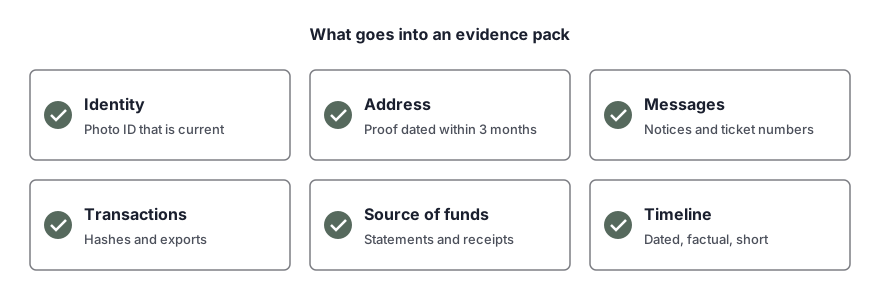
- A document that states why the report is required: a claim, a complaint, a court order, or a letter.
- Your lawyer's name and how to reach them, plus any deadline they have set for you
- The wallet addresses and transaction hashes in scope, marked to show which wallets you control
- Exchange exports, bank statements and receipts covering the period
- Chats, emails and contracts that show what the transfers were for
- A prior analysis, the police report number, or any screening outcome you already have
- We will need a list of the people and organizations involved so the expert can look for conflicts of interest.
What we cannot do
- We cannot serve as an expert witness, and we do not issue signed opinions. The independent expert alone creates, writes, and signs the findings.
- Here is the part we cannot change: no court, tribunal, arbitrator or police unit has to accept a report. Admission and weight depend on the jurisdiction and on the judge or panel deciding.
- We do not promise a particular finding. The independent expert may reach a conclusion that hurts your case, and we pass it on exactly as written.
- We are not a law firm. Legal advice comes from your lawyer, and your lawyer also decides how the report gets used.
- For an expert report, public addresses and your own records are enough. We will never request a seed phrase, private keys or passwords.
Questions people ask
How does an expert report differ from an analytics report?
An analytics report traces funds for someone working in compliance. An expert report is built for a case. It sets out the questions asked, how the expert stays independent, the method used, the facts it rests on, and one reasoned opinion. The expert can also be questioned on it in person.
Can a blockchain expert report hold up in court?
Honestly, we cannot tell you that. The rules on expert evidence change from country to country and court to court, and the judge weighs each report for themselves. A clear method, solid source records and an impartial expert all help. Ask your lawyer to confirm what your forum requires.
Can you write the report yourselves?
No, and this part we cannot change. The opinion must come from an independent expert who forms it and signs it personally. What we do is organise the work, gather the materials, and check the draft reads clearly. We never write or alter the conclusions.
Can I get an expert report without hiring a lawyer?
For court or arbitration, almost always, yes. Lawyers normally instruct the expert, know the formal requirements, and decide how the report gets used. If you do not have a lawyer yet, we can introduce independent licensed lawyers. They work under their own engagement with you.
Is a court appearance required from the expert?
Sometimes, yes. A court, or the other side, may want the expert to explain the report in person or answer questions over video. We settle this ahead of time, and attending is quoted as a separate cost. Keep in mind the expert works independently and is not there to speak for you.
Suppose the expert uncovers a detail that works against me. What then?
An expert states what the records show, plain and simple. We send that finding to you, or to your lawyer, exactly as written. From there, you and your lawyer decide the next step together. We never ask an expert to soften or adjust a finding. Any honest expert would say no to that, and so would we.
How long it takes
A report for the court needs more time than a brief analytics summary. The expert has to lay out the method, the sources, and the limits, step by step. How long this takes depends on the number of addresses involved and on the dates your court has set. After we review your case, we will talk through realistic timelines together, before you commit to anything.
Fees
The first assessment costs nothing, and we tell you whether we can help before money comes up at all. You get the expert's fee basis and our coordination fee in writing, listed separately, before you commit to anything. If the expert has to appear at a hearing, that appears as its own quoted line. Fees →
Related situations
- Reading a blockchain analytics report. A traced source-of-funds report, written for a compliance team to use.
- Preparing digital evidence for crypto cases. Gather and file your chats, screenshots and records so they are usable by police, platforms or lawyers.
- Tracing stolen crypto and requesting freezes. Follow stolen crypto, ask exchanges and issuers to freeze it, and file a police report.
- When authorities freeze your crypto. Your crypto is held by authorities. We connect you with independent lawyers. We cannot give legal advice.
Read next
Sources
These are the official or authoritative pages behind this page. Sources get updated over time, so check them for the current wording.
This page gives general information only. It is not legal advice.